Friday, November 27, 2015

About Motherhood

Because I began motherhood late in life, a woman asked me why I bothered at my age. She said my world was predictably arranged. "Why invite chaos?" she scoffed.

I cobbled together an explanation that probably didn't sound any more convincing than a beauty pageant contestant outlining how she'd achieve world peace.

This November, the traditional month of thankful thoughts, I finally figured it out. Twenty years ago, when that woman confronted me, I had no idea about motherhood. I could never have known how breathtaking it would be to have a daughter who filled in my pauses and finished my sentences.

I see now that it began early on, after we'd returned from China. At eleven months, Maggie babbled in Chinese baby talk. She didn't understand English, but she found a way to speak beyond words. As we napped side by side one afternoon, she sat up suddenly, put a tiny hand on each side of my face, and leaned down to stare into my eyes. I held still as she peered into my soul and promised that she knew me and would forever be on my side.

She was my Merlin.

I realized the depth of her little-girl commitment when we watched Disney's Beauty and the Beast for the first time. In the tavern scene with Gaston, she quickly said, "Mama, don't look," and reached up to shield my eyes. Because she already understood I was upset by stories about animals dying, she didn't want me to notice the walls were covered with the mounted heads of wild game. She protected me through the entire song.

When she was a fourth grader, we took her to a parade. A float with dancing girls rolled by with their organizational slogan scrolled along the side. Maggie asked, "Mom, isn't that apostrophe in the wrong place?" Cliff laughed and said, "Well, she's your daughter without a doubt."

In keeping with our punctuation theme, an odd thing happened when we sold our house last summer. My best friend Laurel had sent me a New Yorker cartoon that I taped to our refrigerator. During an open house, someone took it. It was a loss that could only make an English major suffer. I whined for days. Then it miraculously appeared. Maggie had searched for it online and printed it off. Just for me.

When Cliff and I recently visited her at the College of Wooster's Parent Weekend, she said she had a present for me and handed over a pocket-sized Gideon's New Testament. Because we're not a religious family, she explained. Two boys were distributing them on campus, and she felt terrible over what happened. Polite students were accepting them, not wanting to be disrespectful, but later she'd find the books tossed into trashcans. It pained her. "I know you like little things, Mom, so I kept mine for you." I do love miniature objects. She's watched me move a thumb-sized elephant around the kitchen counter for years. A three-inch by four-and-a-half inch collection of Psalms and Proverbs delights me, but she knew how deeply I'd appreciate her concern for the boys.

Her spirit radiates through my life.

So this Thanksgiving I recited my dad's traditional dinner blessing: For what we are about to receive, may we be truly grateful, and keep us ever mindful of the needs of others. Amen

I looked at her across the table, knowing I was grateful, not for pie and potatoes, but for my daughter. Twenty years ago I was honestly clueless about motherhood, thinking the value centered around what I could offer a child. I had no idea that a baby born on a summer night in China would be the gift I had always needed to receive.

She had everything to offer me.

To leave a comment (I always hope you will.), the program will ask you to "Comment as" and ask you to select a profile.  If you aren't signed up with any of the first 7 account choices, select Anonymous.  This will allow you to Publish.  If you don't, your valuable comment will not appear. 

Monday, October 12, 2015

The Unlikely Truth

Whenever I was ready to give up on something, my mother always said, "Where there's a will, there's a way." I believed her.

It took years to understand she didn't mean it would happen instantly. I've spent a lifetime discovering how much I had to learn, how often I had to fail, and how much I had to depend on the wisdom of others. Instantly? I wish.

When my picture book Sweet Moon Baby: An Adoption Tale was published, I felt obliged to thank three significant people: Florence Parry Heide, Jane Yolen, and Bill Moyers. Florence, an award-winning author, showed me the way early on and insisted I keep my chin up despite rejection. We'd once been neighbors, and she was an easy phone call away.

Jane, another celebrated children's author, took years. Maggie loved owls, so Owl Moon was among her first favorite books. Countless readings showed me the strength of practiced simplicity in a text. I finally met her in March. A happenstance click of a computer key led to a devoted friendship.

I knew all along that Bill Moyers was an impossible reach. When I first started writing picture books, I saw his PBS interview with mythology scholar Joseph Campbell. Listening to them showed me the irresistible pull of a hero on a perilous journey. I realized children's stories required the same epic struggle.

That became the storyline in Sweet Moon Baby: An Adoption Tale.

Still, thanking Bill Moyers was highly unlikely. Celebrities at his station in life are understandably distanced from the little people. Even if I found a contact address on the internet, my note would likely go unnoticed among thousands. I hoped for someone with a public television link. No one ever appeared.

But unexpressed gratitude circles a person, despite the passing time.

Then on Maggie's high school graduation day, I turned to watch her enter beneath the arch. There he was. Several rows behind me. In a pink shirt.

Bill Moyers.

His granddaughter had been Maggie's classmate the whole time, but I never connected the dots on that last name. During the reception, I tactfully avoided approaching him, knowing a potentially embarrassing moment would not be correct. But the aligned stars glimmered too brightly for me to ignore.

We could have chosen other seats on that expansive lawn, and I would have missed him entirely. We didn't. I asked Cliff what he thought the odds were on this intersection, and he said it was a bet no one would ever take.

It wasn't that Bill Moyers needed to know about my appreciation. He had shelves of awards. But I felt duty-bound to tell him my writing turned a corner because of his influential work. Given a direct path to his door, I sent a note with the book. He answered with a handwritten note in the gracious way you would expect. It turned out he truly did need to know about my book. My mother would have said, "Honey, you're walking in mighty tall cotton now."

That's the unlikely truth about gratitude. Sometimes it generates a fate of its own, one far greater than our disbelief. Mine took matters into its hands, flying a famous man all the way to Randolph Avenue in St. Paul, Minnesota, on a day in June.

And making sure he'd wear a color I'd see.

To leave a comment (I always hope you will.), the program will ask you to "Comment as" and ask you to select a profile.  If you aren't signed up with any of the first 7 account choices, select Anonymous.  This will allow you to Publish.  If you don't, your valuable comment will not appear. 

Wednesday, August 19, 2015

Maggie Graduates and Then Some

My daughter amazes me.

Of course, I'm not the first mother to say that. Even my own mother thought so when she said, "Karen, I always knew you were an exceptional child, but you weren't nearly as outstanding as Maggie."

I didn't take offense. I understood what she meant.

Near the end of Maggie's senior year, she was invited to join the Cum Laude Society, an honor organization with admittance based on continued academic success. In a class of 90 students, only eighteen were selected.

She was puzzled.

As she studied the invitation for a celebratory dinner with parents, she explained, "It's not like I worked for this. I just did what you and Dad always said: 'Try your best.' What about the kids who try and try and never get high scores? They've worked a lot harder than I have. What's their reward?"

That's how she thinks, not about herself, but about the larger picture. Things are rarely black or white for her because she knows gray holds considerable meaning.

Many parents believe grades are the gods of success, with inclusion into Cum Laude the pinnacle of achievement. They ground their children for low test performance. They reward them financially for high GPAs. They send them to tutors to improve exam scores. In those families, numbers are everything.

Cliff and I never asked about her grades. Years ago he said to me: "If you're more invested in her homework than she is, no good will come of it." While it sometimes made me crazy in the short term, I understood the big picture of his intent. A child had to be intrinsically motivated to succeed. Otherwise, it was a shell game.

Interestingly, her principal made a statement about each student's inclusion in Cum Laude. Hers began with: "Maggie is smart, perceptive, and responsible." He commented on her concern for social justice, her impact on her community, her empathy for people of various backgrounds and circumstances. He noted her ability to speak her mind while being respectful and her willingness to ask questions no one else was willing to ask. He called her "bright and determined, conscientious and creative."

That had nothing to do with numbers.

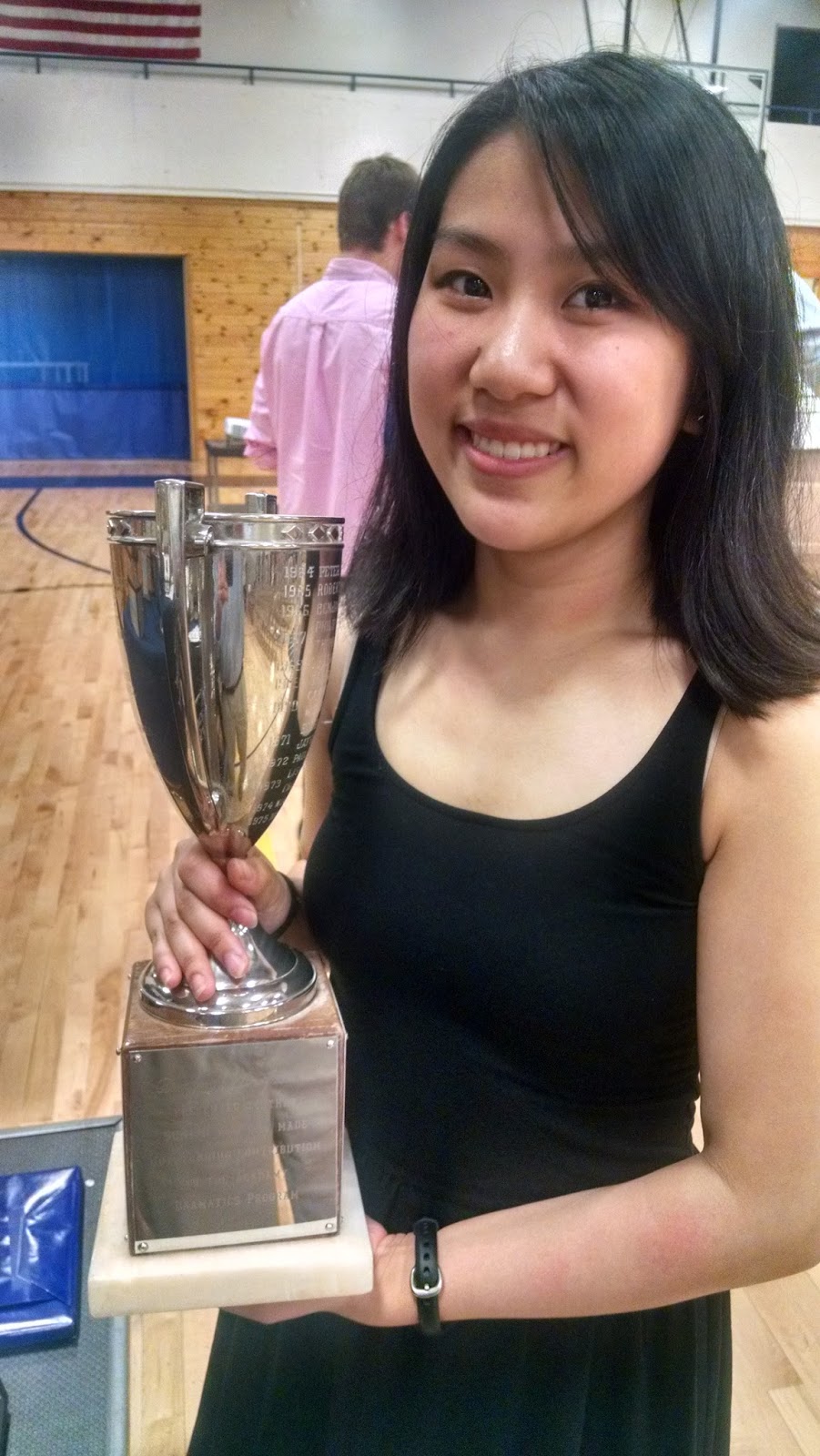
At the school's final awards assembly, she received the Dramatics Trophy. Years ago I was a high school theater director who made the same annual decision. A senior always stood out for onstage or backstage contributions, so I cried silently during the program when her director announced:

"There are few individuals who continuously give over 100% every moment they exist on and off stage. Whether during rehearsal or performance, you are the consummate professional, giving selflessly and tirelessly to every cast and crew, no matter the role. You embrace every production with bravado and an astute attention to detail and true love of the theatrical arts, whether acting, stage managing, or directing. Your abilities and dedication have grown beyond all expectations."

I never had a student like Maggie who excelled at all three.

Awards are great, but I'll tell you what makes me the proudest. Maggie stage managed the spring musical and finally realized how to avoid the behind-the-scenes problems of a limited facility. She purchased neon glow sticks and taped them to the hazardous intersections. She designated the blue ones as crew necklaces so they were easily spotted as the "helpers" for whatever emergencies arose.

Over the years, I've repeated several of Maya Angelou's quotations to her, hoping she would learn that significance in the world depended on her understanding of herself and others. "People will never forget how you made them feel," Angelou wisely wrote. I know people will forget Maggie's starred name in the graduation program to denote her Cum Laude status, but many will remember her glow sticks, not only because they ended the crashes, but because they spotlighted their backstage camaraderie. She had the sense to honor it by making them feel exceptional. Who wouldn't want to work alongside her?

There in the darkness, her brilliance beamed in neon blue. And it had nothing to do with numbers.

To leave a comment (I always hope you will.), the program will ask you to "Comment as" and ask you to select a profile.  If you aren't signed up with any of the first 7 account choices, select Anonymous.  This will allow you to Publish.  If you don't, your valuable comment will not appear. 

Thursday, July 23, 2015

Sudden Angels Part 6: Two Butterflies

Last Sunday I ripped my closet to pieces, looking for a scarf.

I was getting ready for a farewell lunch with my friend Nancy and was determined to wear the gift she gave me at Christmas. I had finally bought a colorful blouse to match it because I haven't worn anything but black and white for years. I thought wearing her gift would be a significant statement about our accidental friendship--how she'd gotten me out of my shell, how she'd gotten me to wear something bright.

Because we're both children's authors, we were seated several years ago at a long table with our books at a kindergarten teachers' convention. I'd recently moved to Minnesota and knew almost no one. Wallflower that I am, I was frozen in my chair.

Then Nancy walked down to my end and introduced herself, the kind of risk with a stranger that paralyzes me. We chatted tenuously at first, but I was smiling by the end. Our quiet personalities breathed easily with each other, as if we were always an intentional discovery, safe and understood in the way of true friends.

Back to the scarf. I looked everywhere, getting more desperate. Because we move next week, I knew it would likely be our last lunch for a long time. Maybe forever. You never know. That scarf was nowhere. So I reached for my standard black and white clothing, feeling guilty, worried that she'd think I didn't appreciate her thoughtful gift.

We had a long lunch, catching up on the good and bad things we'd been through during the past months. Several hours passed, and still we hadn't covered everything. We returned to my house and exchanged hugs and promises at the front door. She got in her car and delayed, rummaging in her purse or whatever.

I stood on the step, waiting to wave goodbye. I waited and waited while she searched.

Then a tiger swallowtail butterfly flew up out of our lilies. Its beautiful yellow wings shimmered in the sunlight as it zoomed toward her car and zipped up and down the length of it in a spontaneous blessing.

There was more.

From the other garden, a monarch darted over the lawn toward the first one. I know butterflies are becoming rare so seeing two at once made a breathtaking moment. The swallowtail backed away. The monarch circled closer until they flew in arcs, crisscrosssing each other's paths. I believe it was an orange and yellow ballet about unexpected friendship.

Later that day, I found the scarf behind a pile of shoes, but it didn't matter anymore. Now I understood the gift was not the scarf. It was Nancy.

To leave a comment (I always hope you will.), the program will ask you to "Comment as" and ask you to select a profile.  If you aren't signed up with any of the first 7 account choices, select Anonymous.  This will allow you to Publish.  If you don't, your valuable comment will not appear. 
Monday, July 13, 2015

Believe

I don't know how many times I walked by without seeing it.

An evening stroll three years ago with our dog Maria finally got my attention. She darted left, yanking me toward the wrought iron fence. I thought she'd spotted a scurrying chipmunk.

Now I'm not so sure what quick creature charmed her. When I looked down where her nose strained through the fence, I saw a fairy village nestled among the flowers. It was sweetly complete with several houses. I was mesmerized.

When summer comes, we visit often, noting how the accessories expand as the fairies prosper. This week our trip coincided with our neighbors' young children. As they approached, Luca (who's probably 4 1/2) called, "Karen, you have to believe." His sister Petra (who's likely 3) ran to point out the tea set. Their sister Filomena (who recently turned 1) watched wide-eyed and silent. I told them that Maria found the spot before I did, and they looked at her with wonder, imagining the possibilities of a dog who sees fairies. "I haven't seen them yet," I said, "but I know I will."

"You have to believe," Luca repeated. "They're very, very fast." Like a flash, he pointed into the branches behind us. As we turned, he said, "I might have seen one!" Petra wanted to know why it didn't fly down to the houses.

Abby, their babysitter, and I looked at each other. I let her take the lead. "Maybe it was afraid of Maria," Abby suggested.

"She would look as big as a dinosaur to a little fairy," I added. The children nodded their heads.

Petra slipped behind the fence. "The chicken fell down," she explained, righting it by the henhouse. I assured her the fairies appreciated her help. She beamed.


Our adventure over, they headed east for home. Maria and I went toward the Mississippi. I thought about that, how I walk west, my eyes always up, expecting the wide, rushing river to be our destination. Somewhere in our American gene structure, we're programmed to believe all good things are toward the horizon. We are pre-ordained to believe powerful things happen in the distance.

But a lot is going on at my feet. If I'll stop and look.

We'll soon be moving away, and these children will forget us, the people next door with the dog who spotted fairies. So I'll have them come over for popsicles with Maggie and me. I'll tell them the tiny tent in our garden doesn't get visitors anymore because of Maria. I'll ask them to put it in their yard for the traveling fairies. They will because they believe.

That's how a meaningful life begins. A boy who believes he saw a fairy flitting through branches will grow up to believe he can master a geometry problem that seems impossible at first. A girl who believes straightening a toppled chicken will help a farming fairy will grow into a girl who confidently helps a friend solve a hard problem. Filomena, quite possibly, will believe that amazing things happen anywhere.

Inevitably in a year or so, they'll ask their parents where the little tent came from. I hope Joe and Katie will say, "From a neighbor who believed in fairies, but more than that, she believed in you."

To leave a comment (I always hope you will.), the program will ask you to "Comment as" and ask you to select a profile.  If you aren't signed up with any of the first 7 account choices, select Anonymous.  This will allow you to Publish.  If you don't, your valuable comment will not appear. 


Monday, June 29, 2015

Sudden Angels Part 5: Nan


This is how I first saw Nan--bent over and busy.  I only knew her as the blonde head among blossoms, clipping and trimming, garden debris flying behind her.

For three years, I walked our dog Maria in silence past her house. So I was startled one morning when she emerged from her garage as I turned down the alley. Face to face for the first time, I told her how much I admired her flowers. She thanked me. We both moved on.

Once our parallel lines intersected, however, we kept colliding on the sidewalk. We chatted. She invited me over for coffee.

I told her what a talent it was to grow lovely flowers. She said it was luck and persistence. "You try something here and watch. If it doesn't grow, you dig it up and move it elsewhere," she said.

Nan told me what a talent it was to write stories. I said it was luck and persistence. "You try this and that with a character, and if it doesn't work, you move it elsewhere," I said.

Out of nowhere, we became friends. Sometimes it happens like that. You wonder why you ever hesitated. In short order, as our stories unfolded, I understood how similar our lives were thematically. There was endless comfort in that. But not for long.

When we put our house on the market this spring, our agent brought in a professional stager who, in that Martha Stewart way, wanted our household turned perfectly inside out. Streamlined and gleaming. All colors coordinated.

"We have to add pops of red outside to attract buyers," I wailed to Nan, who understood by now that I had no talent for landscaping. "I'll pick you up in the morning," she offered. For an hour, she led me down the greenhouse aisles, holding up pots of this and that, asking if I wanted something with more yellow. Or something that trailed. Or something fluffier. At the end, she grabbed tiny white pinprick blooms to add something soft and airy "to set off the red in the geraniums and begonias."

She wasn't singing "Bippity-Boppity-Boo," but I felt the transforming breeze from her wand.

Because I had another real estate brushfire to extinguish across town, she promised to show up the next morning with tools and potting soil to plant everything so we could make the photographer's deadline. And she did. I returned home to brilliant reds in all the right places.

The house sold in a day. Now I have to leave Nan.

Here's what I want you to know about angels. They are not always vertical travelers who sail down on golden rays, as we're led to believe. They can exist on the same horizontal line we travel, bent over among the lilies, waiting to be noticed.

Nan's power was more than those artfully arranged red flowers in our yard. Because of her, I was no longer a stranger in my neighborhood. Someone knew me. Someone watched for me.

Being recognized is a blessing.

I simply had to summon the courage to offer a compliment. Because even angels need kindness.


To leave a comment (I always hope you will.), the program will ask you to "Comment as" and ask you to select a profile.  If you aren't signed up with any of the first 7 account choices, select Anonymous.  This will allow you to Publish.  If you don't, your valuable comment will not appear. 


Saturday, May 30, 2015

Something about Elephants

When it comes to elephants, children aren't afraid. Although huge, they seem approachable. Maybe it's because they don't have claws or fangs or scales. Maybe it's because that curling trunk and tail are odd but happy features.

And who doesn't want to whisper into those enormous ears? A secret could be lost in there forever.

Maggie was crazy about them when she was a little girl. Her comforter was imprinted with Victorian zoo elephants in elaborate gazebos. She had a collection of souvenir elephants. When her class made kitchen magnets for the parents, she drew Ella, her favorite stuffed animal.

When Cliff taught first grade, it was an elephant who finally turned the tide with a difficult class. They were a group of mismatched spirits given to arguing, refusing to compromise with each other. Knowing it would be a long, unhappy year, he decided to show them the value of creating a community by creating a gigantic task that could only be successful as a group effort.

An elephant saved the day.

They studied India as a lesson in geography and culture. Traditionally kids drew maps or gave historical reports about the country, but these were solitary endeavors. Cliff changed it up by announcing they would draw a life-sized Indian elephant and divided them into groups: the eye committee, tail committee, front leg committee, etc. They researched their assigned dimensions, a process that forced them to talk to each other. Then he asked them to bring in newspapers, which tells you this happened before the days of the internet. As a class, they estimated how many sheets they'd have to tape together to form a large enough surface to draw the animal. They pushed all the tables and chairs against the wall, another maneuver that required them to work together.

Each group had a roll of tape and stack of newspaper. Each member had to get a turn taping. More cooperation was required because everyone couldn't hold the tape at once.

Then they realized the eye couldn't be drawn until the head was sketched in. The tail couldn't hang in midair. The stomach had to wait for the leg placement. Much conversation ensued. Kids were patient with each other. Markers were handed back and forth. They positioned themselves around the perimeter and began to cut--without bumping each other.

Instead of accusing and blaming, the room was filled with giggles and silence as the elephant took shape. The scraps were collected, and it became a lesson in recycling, too.

When the amazing animal was drawn, Cliff extended the lesson by asking questions requiring educated estimates and concrete actions like: How many children can line up on the length of a trunk? How many of your feet equal the length of the elephant's foot? How many hands fit on the eye?

Children once determined to get in front of each other, scooted over for someone else to add a little hand. They guessed together and listened to each other.

Yes, they created a huge elephant. More importantly, they learned a huge lesson about the power of cooperation.

Any teacher can present facts. Any teacher can grade fill-in-the-blank worksheets. Only a remarkable teacher can create invaluable life lessons. With the help of an elephant, he showed a class how to see each other.


To leave a comment (I always hope you will.), the program will ask you to "Comment as" and ask you to select a profile.  If you aren't signed up with any of the first 7 account choices, select Anonymous.  This will allow you to Publish.  If you don't, your valuable comment will not appear.