Monday, February 6, 2017

Hail Mary Pass

Every year we watch the Super Bowl, although I'm mostly interested in the snacks and half-time show.

I don't know a thing in the world about the game itself, but I know a metaphor when I see it.

It looked bad for the New England Patriots on Sunday night. Tom Brady threw pass after pass that overshot the mark, when he could even get the ball into the air. Time and again he was knocked down.

As successful as he'd been over the years, nothing worked for most of the game. The camera often showed him slumped on the bench, looking baffled. Who could blame him? But he never looked defeated. He'd get up and run onto the field once more when his team had the ball. And he'd watch his plan slip out from under his fingers yet again.

People said Brady couldn't do it. He couldn't fight the odds as the Falcons' score charged ahead.

He did though.

That's the part about football that takes my breath away.

I know they practice relentlessly. I know a plan requires someone to break loose and run left as
someone else tackles so and so and the quarterback throws a ball. But in the tangled collisions, as the quarterback steps free, every pass looks like a Hail Mary to me. With hope sailing on a wing and a prayer, a teammate rises above his own doubt. He catches the ball and runs. Weaving through those stampeding mountains, he sprints across a thin white line of disbelief.

You can say it's all about muscle and strategy.

To me, it's a matter of faith.

That's what happened at the critical second when Brady threw and James White caught. 

I say this, not because I have any insight into sports, but because I know that slumped-on-a-bench feeling.

Authors famously recount tales of receiving dozens of rejections, searching for that one editor who rises up, contract in hand, to seize the project.

Talent aside, it's a writer's resilience, sometimes spanning decades, that gets a manuscript over the thin white line.

Recently I tacked note cards with colored stars on my bulletin board. They chart my effort. Every time a rejection arrives, I have a choice to stay on the bench or run onto the field. No cameras. No crowds. Just me, a story, and another Hail Mary Pass.

But you don't have to be a writer or a quarterback to understand facing impossible odds.

Someone eating popcorn in the stands will always think you can't do it.

But someone will think you can.

Go on.

Throw. 

To leave a comment, the program will ask you to "Comment as" and ask you to select a profile. If you aren't signed up with any of the first 7 account choices, select Anonymous. This will allow you to Publish. If you don't, your valuable comment will not appear. If you'd like to receive other posts, click on FOLLOW at the top of this page.
   

Monday, January 30, 2017

The Women's March in DC: The Epilogue

This picture was taken before Maggie's feet ached inside her muddy shoes. Before she'd been jostled for six hours. Before part of the group wandered off. Before the others panicked and set out to find those four needles in a haystack. Before she realized their leader had  organizational issues.

Even after all those befores, she said she'd do it again. She's not annoyed or afraid.

She's determined.

Change happens because the end result is more important than the sharp edges.

So whatever Maggie thought the day would be like, she adapted once she arrived. She was on a mission and grabbed it for all it was worth.

For my part, I spent that Saturday waiting for a picture that never came. I hyper-focused on a picture of her and her alone in that t-shirt. Isn't that just like a mother? My daughter took pictures of great posters and interesting details along the route. None of herself.

The pictures I finally received of her were taken by others who traveled with her. (Mothers, probably.)

When she sent me her reflections for Part 2, especially her Lin-Manuel Miranda quote about the ultimate significance of seeds, I remembered a song called "Plant a Radish" from The Fantasticks. Two fathers sing:

          Plant a radish.
          Get a radish.
          Never any doubt.
          That's why I love vegetables;
          You know what you're about!

          While with children,
          It's bewilderin'.
          You don't know until the seed is nearly grown
          Just what you've sown.
    
I was mistaken to think she'd be a selfie-taking Millennial on such an important occasion. Or that what I wanted was truly necessary. In fact, when she read Part 1, she admitted the day had been another Winnie-the-Pooh moment, just as I described. I thought about that--her breakaway dash at Disneyland. Never a risk-taker, she realized even then she'd never be lost.

We'd be right behind her.

When you look at her in this picture, you see an enthusiastic girl.

And me? I see my radish.

A prize-worthy one indeed.

And I'm still right behind her.
          
To leave a comment, the program will ask you to "Comment as" and ask you to select a profile. If you aren't signed up with any of the first 7 account choices, select Anonymous. This will allow you to Publish. If you don't, your valuable comment will not appear. If you'd like to receive other posts, click on FOLLOW at the top of this page.


Thursday, January 26, 2017

The Women's March in DC: Maggie Takes to the Streets

Protesting or resisting. It's a tough business.

You either discover yourself in a group venture or you get lost in it.

And at the end of the day, you make a decision about the price of admission. Because there certainly is one if you raise your hand to power and say, "Wait a minute."

Authority never rolls over without a fight.

So I asked Maggie what she thought the march would be like and what she thought would happen.

On reflection, she admitted thinking it would be a great trip with friends, hanging out, taking pictures,
chanting about common beliefs. She never saw this as complaining about a President. She believed in supporting significant issues being swept aside.

She was ready. She was present.

What she got was a long, scary bus ride in the fog. Fitful sleep. Disorganization and mixed messages. Erratic cell service. Pushing and shoving. Padlocked Porta-Johns. Muddy fields. Aching feet from six hours of walking and nowhere to sit. Frazzled nerves and worry because four girls wandered off and never returned.

At one point, she stood with friends by a tent left over from the inauguration. It displayed a refreshment sign, and people kept lining up for food. "Whoever set up there could have made a lot of money," she said to me.

Protests don't come with cake pops. But those young passersby, raised on endless Starbucks, wouldn't know demonstrations don't include concessions. This rally was their first time on the streets, after all.

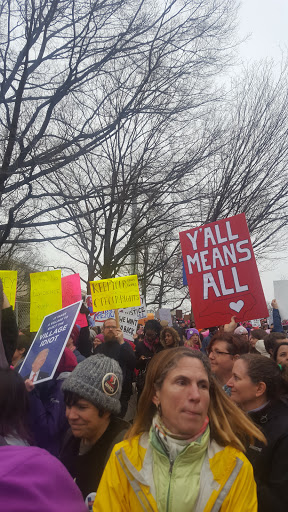
Still, she took the experience in, texting when possible about her location. We'd get aerial views on TV of where she stood. No, we never saw her face, but we witnessed her heartfelt presence. She sent pictures of her favorite posters. Like the good Southern girl she once was, the Y'ALL slogan pleased her no end. She appreciated the witty signs from clever people and valued seeing her own thoughts expressed in neon colors.

She heard inspiring messages from Gloria Steinem and America Ferrera, women from different generations, whose remarks mirrored her own beliefs. Although the massive crowd made it impossible to literally march past the White House, she saw it in the distance. On the metro, three older women from San Diego asked her group about their thoughts on the march, reinforcing that she was part of something beyond age or geography.

For the first time in her life, she uses sisterhood, understanding its long history and feeling appreciated for her newfound place there.

She belongs to the tradition built step by step.

With no intention of going back.

In prime Maggie fashion, as if she were completing an essay exam, she wrote to me about the significance of fighting for social justice, a fight often plagued by lonely uncertainty. To illustrate her point, she quoted from Hamilton: An American Musical with this line: "What is a legacy? It's planting seeds in a garden you never get to see."


To leave a comment, the program will ask you to "Comment as" and ask you to select a profile. If you aren't signed up with any of the first 7 account choices, select Anonymous. This will allow you to Publish. If you don't, your valuable comment will not appear. If you'd like to receive other posts, click on FOLLOW at the top of this page.

Sunday, January 22, 2017

The Women's March in DC: The Prologue

Because Maggie is the President of College of Wooster's chapter of Planned Parenthood, it seemed likely she'd attend the march.

Along with women's issues concerning respect and reproductive freedom, she's an immigrant, a minority, and a new voter.

Wooster's Westminster Presbyterian Church contacted her about filling the eight seats they'd reserved for her group on their bus. The girls would be under the guidance of activist women who'd experienced previous marches.

Easy peasy transportation.  

While she was home for the holidays, preparations began. Details from the church liaison. Rounds of questions. Waiting lists. Times and places decided. Participant regulations texted. Metro pass snafus untangled.

It's not the 60s anymore. More is required than tie-dyed clothing and a poster.

When the official t-shirt arrived, I resorted to my best shrinking methods because her petite frame baffles all standard sizing. When the sleeves remained too long, I suggested visiting our seamstress. But Maggie said she'd make the best of it.

We found warm, flexible gloves for texting during the march.

I bought protein bars and foil-wrapped chocolates to fill her pockets. Because I love a metaphor, heart-shaped candy expressed my love for her courage, especially since she explained her 2017 New Year's Resolution is to fight complacency. She knows it's easy to hit LIKE on social media, another thing entirely to actually work for change, step by step.

Our local library staff wished her well, too, praising her strong character and adventurous spirit. Maggie smiled. I beamed.

A friend suggested I attend the march with Maggie. She saw the march as a grand mother-daughter gesture. "This is her defining moment. I'd be in her way," I said.

As I drove her back for the second semester, I asked for a picture of her in that t-shirt. And one of her with the campus friends traveling with her by bus. In my experience, Millennials love smiling group shots and momentous selfies. They flood FB. On a bus filled with supportive women, I knew there'd be no trouble getting a volunteer photographer. In Maggie's history, finding supportive, like-minded friends is a constant challenge. Finally she's found them, I believed.

I couldn't wait to see these pictures. They'd be right up there with the Disneyland picture of her squealing, enthusiastic hug for Winnie-the-Pooh at age three. Yes, it was adorable, but the incredible detail not captured on film was her letting go of our hands and running alone down the sidewalk. Never a risk-taker, she surrendered completely to a beloved presence.

I kept telling her what a significant life experience this would be. She'd be forever changed.

She's heard my horrific tales of being at Ohio University in May 1970 when the Kent State killings occurred. Riots eventually closed our campus. Students had 24 hours to clear out. My incredulous mother drove our packed car through the town's streets lined with armed National Guardsmen.

"I realized I was seen as the enemy," I add when I tell Maggie the story. "You never get over that."

I doubted she'd face weapons.

But I knew she'd end up feeling empowered. And changed.

To leave a comment, the program will ask you to "Comment as" and ask you to select a profile. If you aren't signed up with any of the first 7 account choices, select Anonymous. This will allow you to Publish. If you don't, your valuable comment will not appear. If you'd like to receive other posts, click on FOLLOW at the top of this page.


Tuesday, January 3, 2017

Guest Blogger: Tim Blake Nelson


[From 1976-1983, I taught English and directed plays at Holland Hall Upper School in Tulsa, Oklahoma. I was twenty-four and had negligible experience. I didn't know up from down about teaching, but during those years, a handful of students changed me irrevocably. Over three decades, one way or the other, they've found me. I recently invited them to become guest bloggers, reflecting on something about their high school selves.

Tim Blake Nelson, Class of 1982, took me by storm. Every day. For four years. Countless interactions with him in class and rehearsals reduced me to giggles or tears, soul-searching tears. In morning meetings he often impersonated faculty members. Several of them confronted me in the lounge and demanded to know why he did that. Panicked, I knew I had to save him, so I said he’d either become an actor or a writer and was practicing dialogue and characters. (Shocked silence. I sounded crazy, but I believed that was his destiny.) I insisted he meant no harm. He probably did, but I knew better than to throw him to the angry mob. Yet I repeatedly held his feet to the fire in other ways. When I refused to give him an A on his sophomore research paper, the English Department revolted against me. “In twenty years it won’t matter,” a colleague contended. “It will to Tim,” I said. “He’ll see it wasn't an A and be embarrassed for himself and ashamed of me.” Tim called, almost on cue in twenty years, and said, “You were right, Karen. It wasn’t an A.” This rowdy boy changed the trajectory of my life. Even now, no one can push all my unsuspecting buttons the way he still does.]

                                                                              ***

This is going to be boring, because it’s not a story of struggle or duress. High school in many ways mapped out my life. During those years (for me 1978-1982), I began to engage in aspects of every pursuit that occupies me now. I wrote and acted in my own scripts, took lots of photographs, read and wrote a great deal, and acted in as many plays as would have me. I encountered extraordinary teachers, including the one hosting this blog, and I learned how to take from them what they gave, while endeavoring to give back some measure of myself by way of enthusiasm at the very least. Above all, I gathered that a great education and a good deal of work and determination make anything possible. This is a simplistic cliché in which I still believe, much to the frustration of my inculcated children.

Like most at my private school, I grew up in relative privilege. I had access to a family car, a bit of money to spend on weekends, and a room of my own with a door I could close. I lived in a safe neighborhood, and there were both the expectation and means for me to attend college. My best pals and I went off mostly to fancy schools that provided extraordinary educations. Additionally, we got to do this from Tulsa, Oklahoma; what remains to me a contrapuntally exotic place because it offered little allure to the homogenizing corruptions of the outside world. Yes, it was middle America, but a middle America largely hidden from view because folks didn’t go there to visit, but to live. There were few tourists, and therefore none of the places that catered to them, allowing a kind of genuineness to pervade. When I eventually moved East for college, I got to come therefore from a place remote and specific; I was the only kid in my class of twelve hundred from my state, and that felt special.

I was small, Jewish, not particularly athletic, and not among the very smartest scholastically, so my currency came mostly from being funny, a pursuit I pushed hard, and at which I often succeeded but also occasionally faltered. My humor could be cruel, disrespectful, and when it was I knew instantly.  I learned through failure about laughter in its more benign and even constructive forms, how when humor lacerated, it needed to have a purpose. Somehow I got a girlfriend who was smart and kind and very pretty. She drove a Jeep Renegade and was the star pitcher on the softball team. When she would periodically break up with me, being funny, let alone doing schoolwork, felt impossible.  When we’d get back together, I felt invincible. My friends all loved her, a few of them a bit too much for my liking.

My sophomore year, on the night my girlfriend and I had our first real kiss, my father walked out on my mother, initiating what would be an ugly and attenuated divorce over the next several years. My mother was in unbearable pain, and selfishly I often couldn’t take it, so I hid in my schoolwork and social life, throwing myself into every activity I could, and pursuing the most advanced courses available (except for math, at which I was preternaturally abysmal). I escaped from real life and real pain, in other words, with a new enthusiasm for school. My best buddy JB and I edited the paper our junior year, driving my car onto the floor of the indoor commons to deliver the April Fools edition. It helped us to avoid punishment that he was the headmaster’s son. For my senior year, I was elected student council president. With my friend James, I did skits we would write and perform during morning meetings, often twice a week, for every event or item that needed to be advertised. My grades improved steadily, and with a cadre of enthusiasts I fell in love with Latin and the teacher who taught it. Our clan would study late into the night, reading and translating Catullus and Horace and Virgil. 

There was also a good deal of drinking…and driving. How none of us was maimed or even killed—how we didn’t maim or kill others--remains a mystery to me. Every weekend night involved some form of cat-and-mouse with the local constabulary who would search us out in their prowlers in abandoned parking lots, behind churches, or on backroads and overlooks where we’d guzzle Mickeys Big Mouths, Little Kings, or Cold Duck. Had our parents known, we would have been slaughtered.  There was plenty of pot around too, but I liked the booze, and spent my last prom night in jail for public intoxication.  Ultimately I didn’t care, as shameful and stupidly dangerous as it was. I was graduating, and high school had been glorious.

In contrast, my first months at college were awful. I was lonely, unfulfilled, and lost.  I missed my girlfriend, my still struggling and extraordinary mother, my friends, my complete life and its sense of purpose. Yet most of all, even in a homesickness that would eventually abate, I felt lucky. Yes, I’d had ups and downs—breakups, a bad grade here and there, my parents’ divorce, not being cast in a play, an arrest, friends who betrayed me—but by and large high school was something I’d assayed with a verve and enthusiasm that had rewarded me dearly. I had teachers who encouraged and truly cared (again, topping the list the host of this blog), along with a smart and varied group of friends, and a girl who taught me how to love. People laughed at me when I wanted them to, and were interested in the stories I was beginning to tell. I was learning to control and focus that in a way I sensed someday might have meaning. 

I left Tulsa, in other words, with a burgeoning sense of what my life could be, and because of that, I feel like I’ve been living it fully ever since.

                                                                             ***

Tim Blake Nelson, a graduate of Brown University and Juilliard, is an actor, writer, and director. He lives in New York City with his wife and three sons.

Wednesday, December 28, 2016

What Your Children Wish You Knew

I said nothing at the time.

At a children's birthday party, one mother announced her four-year-old son had asked for trumpet lessons. Several parents complimented the boy's interest in music.

"No!" she responded. "I'm not listening to hours of trumpet practice! I told him he could learn the violin or piano."

I felt terrible for the curious boy who was intrigued by a trumpet. The sound? The shine? The keys? Only he knew. Somehow he saw himself through that instrument, but when he asked for help from the most likely person, his mother threw a pie in his face.

She taught him his dreams had to be her dreams.

No matter their age, children know about their lives, their purpose. They feel the nudge pushing them a certain way. The dream might seem odd at the time. It isn't.

When Maggie was in third grade, she wanted to learn to ice skate.

In North Carolina? I thought to myself. We weren't even in the mountainous part of the state that got subzero temperatures. Where would I ever find a frozen surface?

Still, I realized something invisible tapped her shoulder. I considered her life as a Chinese adoptee. As a toddler, the one Chinese person she saw on television was Michelle Kwan. Maggie faithfully watched her compete in the Winter Olympics, imitating her movements across our carpet. Her Famous Americans report in first grade was on the champion figure skater. One Christmas I gave her a snow globe of Kwan.

Unlikely as it first seemed, the ice skating dream had been a long time coming. Every child wants to be like someone, and Maggie identified with the only Asian face she saw in a sea of white ones.

So I asked around, discovering an indoor court at the fairgrounds was frozen for several months each winter. Cliff and I signed her up for private lessons, not sure our athletically reluctant daughter understood what she was bargaining for.

Maggie took this seriously because it was her decision, not ours. She was intrinsically motivated to succeed, earning four badges from the Ice Skating Institute for mastering a series of skills. No one else could do that for her. Alone on the ice, she won, not ribbons or trophies, but personal success.

Awards end up in cardboard boxes.

Self-confidence lives forever.

And I saw hers in action on a particular Sunday afternoon when the arena was open to the public. A small girl wobbled along by herself in the crowd and fell. Indifferent people whizzed by the sprawled beginner who could not get her footing. But Maggie saw. Zipping along with more speed than usual, she wove through the crowd until she knelt beside the child and helped her reach the rail.

There was our daughter--all skating courage. For Maggie, it was never about costumes or competition. None of that interested her. But confident skating allowed her to test herself in another way, a generous way.

That's when I understood her dream. Ice was her way of taking an inevitable first journey on her own.   

Children need to feel brave.

That's the point of parenting--helping children test their strength in ways we might not choose. We're simply required to believe. I hadn't bargained for the countless cold hours I'd spend sitting in a dimly lighted rink, but I did it. Because the dream inspired her heart, it inspired mine.

Parents need to think of their child's dreams as a boat for crossing precious early waters. Refuse to be like the mother at that birthday party who thoughtlessly sank her son's ambition.

Instead, hand over a paddle.

Or trumpet. Or ice skates.

Then stand back.

This isn't about you.


To leave a comment (I always hope you will.), the program will ask you to "Comment as" and ask you to select a profile. If you aren't signed up with any of the first 7 account choices, select Anonymous. This will allow you to Publish. If you don't, your valuable comment will not appear. If you'd like to receive other posts, click on FOLLOW at the top of this page. 

Wednesday, December 21, 2016

Christmas 2016: Toddler Coat Politics

In the days approaching Christmas, life is sporadically peaceful.

While kitchen multi-tasking, I set a sheet of parchment paper on fire. No cookies were lost. Our dog Maria recently took a fall and couldn't walk, landing her at the vet's with us carrying her in by towel sling. Two weeks ago I undertook a harrowing drive through an arctic snow blast to Cincinnati so I could help my friend Laurel. Her inner-city church sponsors an annual family gift distribution and depends on volunteers. I'll be processing this experience for the rest of my life.

This spring Cliff had two ER runs because of soaring blood pressure. After hospitalization and countless tests, he's back on his feet and better than ever. Because no one loves a road map more than he does, he's traveled to North Carolina's Merlefest and visited Nova Scotia with his friend Allen. Although they covered miles of gorgeous scenery, I suspect they appreciated the pubs and Irish music best of all.

In the fall, we toured Williamsburg and Monticello for the gazillionth time. Cliff loves history; I love beautiful buildings. Because he's teased me forever about my bouts of fiery rhetoric, he scheduled a trip to Patrick Henry's farm in Scotchtown so I could stand where he wrote his "Give Me Liberty" speech. There's something reassuring in knowing I share the genetics of another writer who was not always well received but was right, nonetheless, I choose to believe. 

Maggie is considering a major in sociology or psychology. This summer she worked as a guide at the Thomas Edison Birthplace up the street and volunteered at the library's cooking class for children, meaning she can speak at length about light bulb filaments and aversions to lettuce. If there's a career in there, she'll figure it out, coupled with her devotion to campus dogs. As president of their Planned Parenthood chapter, she's attending the Million Women March in January. With Cliff's protest of Spiro Agnew's visit to Oklahoma and my being at Ohio University during the Kent State Massacre, she continues the family forays into political hot zones.

Of all the places we've lived, oddly enough we've had more company in Milan than anywhere else. We're happy but puzzled at the same time. Quiet and historic, little happens here. Nevertheless, plenty of guests have been mesmerized by our butterfly bush covered with a flurry of winged creatures two-stepping from leaf to leaf. Who could have guessed one plant could accomplish so much good? In a world where bees and butterflies are dangerously challenged, they flourish around our porch. Amazingly, one monarch actually sat for twenty minutes on my arm.

If you read my August post Crazy Corn, you know about my alarming moment with a local farmer's political views. There's plenty of crazy on both sides these days. Last weekend at that Cincinnati church, I worked alongside a volunteer whose national opinion was vastly different from mine. Rather than needlessly arguing, I searched for our common connection. Turned out, we were just two people who'd grown up in Ohio's Rust Belt and knew about lean times.

After winning his confidence, he told me he'd explained the need in this church to his affluent co-workers. One colleague responded by saying, "If you keep giving free things to those people, they'll never get jobs." He asked the man how many three-year-olds he'd ever seen buying their own coats. "I'm looking out for the innocent children who can't help their circumstances," he said to me. Who'd disagree with that point of view?

So that's my advice. Find the commonality.

Patrick Henry said: "We are not weak if we make a proper use of those means...placed in our power." Few of us can accomplish revolutionary change, but we can influence our corner of the world.

We can do something.

March. Plant a butterfly bush. Donate a toddler coat.

Do good wherever you are.

You always have that power. Always.

To leave a comment (I always hope you will.), the program will ask you to "Comment as" and ask you to select a profile. If you aren't signed up with any of the first 7 account choices, select Anonymous. This will allow you to Publish. If you don't, your valuable comment will not appear. If you'd like to receive other posts, click on FOLLOW at the top of this page.